Course-wide Conventions & Notation
Overview and Learning Objectives
A particle in a box is the simplest quantized model of translation and provides a clean route to the translational partition function. We review the 1D and 3D energy levels, derive in the high-temperature/large-volume limit, and use to recover ideal-gas thermodynamic relations.
Learning objectives:
Write the quantized energy levels for a particle in a 1D box and generalize to a 3D rectangular box and cube.
Derive the single-particle partition function and its continuum approximation in the limit of small level spacing.
Define the thermal de Broglie wavelength and express .
Use to obtain , , and .
Core Ideas and Derivations
Review of the Particle in a Box
Particle in a One-Dimensional Box
Source
import numpy as np
import matplotlib.pyplot as plt
from mpl_toolkits.mplot3d.art3d import Poly3DCollection
from scipy.constants import k, eV
from labellines import labelLines
from myst_nb import glue

fig, axs = plt.subplot_mosaic([[0]], figsize=(4, 4))

# Plot a one-dimensional box
axs[0].plot([-0.5, -0.5], [18, 0], color='black', zorder=2.5, lw=4)
axs[0].plot([-0.5, 0.5], [0, 0], color='black', zorder=2.5, lw=4)
axs[0].plot([0.5, 0.5], [0, 18], color='black', zorder=2.5, lw=4)

# Plot the energy levels (blue lines)
for n in range(1, 5):
    energy = axs[0].plot([-0.5, 0.5], [n**2, n**2], color='blue', label=r'$E_{%d}$' % n)
    labelLines(energy, xvals=[-1/6], zorder=2.5)

# Plot the wavefunctions (red curves)
x = np.linspace(-0.5, 0.5, 100)
for n in range(1, 5):
    wavefunction = axs[0].plot(x, np.sin(n * np.pi * (x + 0.5)) + n**2, color='red', label=r'$\psi_{%d}$' % n)
    labelLines(wavefunction, xvals=[1/6], zorder=2.5)

axs[0].set_xlabel('Position')
axs[0].set_ylabel('Energy')
axs[0].set_xticks([-0.5, 0, 0.5])
axs[0].set_xticklabels([r'$-L/2$', r'$0$', r'$L/2$'])
axs[0].set_yticks([])
axs[0].spines['top'].set_visible(False)
axs[0].spines['right'].set_visible(False)
axs[0].spines['left'].set_visible(False)

plt.tight_layout()
plt.show()
plt.close(fig)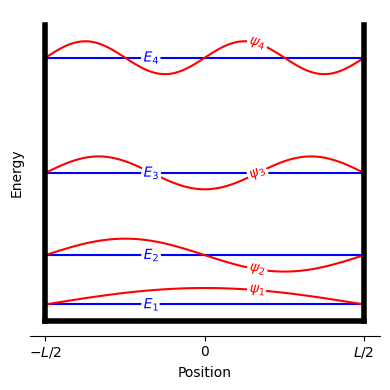
Energy levels (blue) and wavefunctions (red) for a particle in a one-dimensional box with boundaries at .
For a particle in a one-dimensional box of length , the quantized energy levels are
where is Planck’s constant, is the particle mass, and is a positive integer.
Particle in a Three-Dimensional Box
In three dimensions, the energy levels are
where , , and are positive integers, and , , and are the respective side lengths of a rectangular box.
Particle in a Cube
For a cube of side , . The energy simplifies to
where is the cube volume.
Partition Function for a Particle in a Cube
The single-particle partition function for a three-dimensional cube is
Define . Then
Approximation of the Sum
When the level spacing is small (large or large ), the sum is well approximated by an integral:
Substituting gives
We often define the thermal de Broglie wavelength as
Hence,
So the single-particle partition function becomes
Partition Function for Particles in a Cube
For identical, non-interacting, indistinguishable particles, the total partition function is
The factor of corrects for particle indistinguishability: permutations of identical particles do not produce new states.
Ensemble Averages for Particles in a Cube
Natural Logarithm of the Partition Function
Taking the logarithm of gives
Often, the Stirling approximation () is used for large .
Internal Energy
The internal energy follows from
Heat Capacity at Constant Volume
From , it follows that
Pressure
To find the pressure, we use
recovering the ideal gas law.
Translational Partition Function
Because the particle-in-a-box spectrum describes translational motion, the single-particle partition function
is called the translational partition function. It underpins the classical description of dilute gases when (typical particle spacing), so quantum effects are negligible at ordinary densities and temperatures.
Computational Studio: Ideal Gas
Use the interactive studio below (or open it in a new tab) to vary particle count (), volume (), and temperature (). The studio visualizes how these parameters affect the gas while showing , , and derived from the partition function.
You can open the studio in a new tab: Ideal Gas Computational Studio.
Worked Example
Estimating and (helium, 300 K)
For a particle of mass , the thermal de Broglie wavelength is
Take helium: , .
Compute
Compute the single-particle translational partition function in
Result. in macroscopic volumes, consistent with the continuum approximation used to derive .
Concept Checks
Why does the sum over quantum numbers become well-approximated by an integral at high or large ?
What does the condition “interparticle spacing ” mean physically?
Why does translation give but not for an ideal gas?
Where does the factor enter when connecting microscopic states to macroscopic entropy?
Key Takeaways
Quantized translation in a box leads, in the continuum limit, to .
sets the scale of quantum wavepacket “size”; classical behavior emerges when is small compared to typical spacings.
For an ideal monatomic gas, reproduces and .
Partition functions connect microscopic spectra to thermodynamic equations of state via derivatives of .